


## Introduction
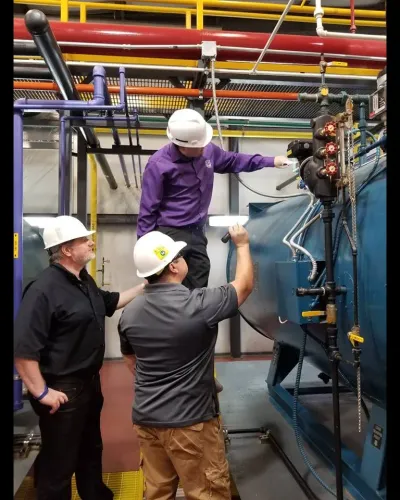
**Boiler hydrostatic testing, commonly known as boiler hydro testing, is a critical inspection procedure used to verify the structural integrity, pressure resistance, and leak-tightness of boilers and associated pressure-retaining components.**
Whether a boiler is newly manufactured, commissioned, repaired, or subjected to major maintenance, hydrostatic testing helps identify potential weaknesses before the equipment is placed into service.
A **high-pressure hydro test pump** is an essential part of the testing arrangement. It provides the required water pressure in a controlled manner, allowing the boiler and its pressure-containing components to be inspected under specified test conditions.
For industrial facilities where **safety, reliability, and minimum downtime** are important, selecting the appropriate hydro test pump is a key part of the testing system.
## What Is Boiler Hydrostatic Testing?
Boiler hydrostatic testing is a pressure test in which the boiler is completely filled with water and pressurized to a specified test pressure.
Unlike pneumatic testing, hydro testing uses water as the test medium. Hydrostatic testing is an established method for evaluating pressure-containing equipment when performed according to the applicable code and approved procedure.
During the test, the following components may be inspected:
* Boiler drums
* Water tubes and fire tubes
* Headers
* Economizers
* Superheaters
* Welded joints
* Tube-to-header connections
* Flanges and gaskets
* Valves and fittings
* Associated pressure piping
The objective is to identify leakage, abnormal pressure loss, deformation, or other indications that may compromise the integrity of the pressure system.
> **Important:** Hydro test pressure, holding time, acceptance criteria, and test procedure must be established according to the applicable statutory requirements, boiler code, manufacturer specifications, and approved inspection procedure. They should not be assumed to be the same for every boiler.
## Why Is Boiler Hydro Testing Important?
Boilers operate under high temperature and pressure. Any weakness in a pressure-retaining component can result in leakage, unplanned shutdowns, equipment damage, or serious safety risks.
Hydro testing provides an opportunity to identify potential problems before the boiler returns to normal operation.
### 1. Leak Detection
Hydro testing helps identify leakage from tubes, welds, flanges, valves, fittings, and other pressure-containing connections.
### 2. Structural Integrity Verification
The test provides a controlled method for verifying that pressure-retaining components can withstand the specified test conditions.
### 3. Post-Repair Inspection
After tube replacement, welding, pressure-part repair, or major maintenance, hydro testing can help verify the integrity of the repaired section.
### 4. Commissioning Verification
For new or modified boiler systems, hydro testing forms an important part of the inspection and commissioning process, where required by the applicable standard.
### 5. Improved Reliability
Identifying defects before operation can reduce the possibility of leakage, unexpected shutdowns, and costly corrective maintenance.
## Boiler Hydro Testing Procedure
A professional hydro testing procedure should be prepared and approved according to the specific boiler and applicable requirements.
### 1. Pre-Test Inspection
Before filling the boiler:
* Complete required fabrication and repair work.
* Verify that welds and pressure parts are ready for testing.
* Check valves, flanges, fittings, hoses, and connections.
* Confirm that components not designed for the test pressure are isolated.
* Verify the calibration status of pressure gauges and other test instruments.
### 2. Filling the Boiler With Water
Fill the boiler completely with suitable test water.
Proper venting is important because trapped air can affect pressure stability and increase the stored energy of the system.
### 3. Connect the High-Pressure Hydro Test Pump
Connect the high-pressure hydro test pump to the designated test connection.
The pump should be selected according to:
* Required test pressure
* Required flow rate
* Boiler volume
* Available power supply
* Test arrangement
* Site conditions
### 4. Controlled Pressurization
Start the pump and increase the pressure gradually.
Controlled pressurization allows operators to monitor the system and identify abnormal conditions during pressure buildup.
### 5. Achieve the Specified Test Pressure
Increase the pressure to the test pressure defined by the applicable code, manufacturer, or approved test procedure.
**The test pressure should never be selected only on the basis of the pump's maximum pressure.**
### 6. Pressure Holding and Inspection
Maintain the specified test pressure for the required duration.
During this period, inspect accessible pressure-retaining components for:
* Visible leakage
* Pressure loss
* Abnormal deformation
* Tube leakage
* Weld leakage
* Flange leakage
* Other signs of structural abnormality
### 7. Pressure Release
After completion of the inspection, release pressure in a controlled manner.
### 8. Drainage and Post-Test Inspection
Drain the test water and carry out any required drying, cleaning, or post-test inspection before returning the boiler to service.
## Selecting the Right High-Pressure Hydro Test Pump
Choosing a hydro test pump based only on maximum pressure is not sufficient. The complete testing requirement should be evaluated.
### Required Test Pressure
The pump must be capable of reaching the specified test pressure with an appropriate operating margin.
### Flow Rate
Flow rate determines how quickly the system can be filled and pressurized.
### Boiler Volume
Larger boiler systems require more water. Pump flow should therefore be selected according to the required filling and pressurization requirements.
### Pump Construction
For frequent industrial testing, a robust **reciprocating plunger pump** can provide reliable high-pressure operation.
### Drive Arrangement
Depending on site requirements, the pump can be configured with a suitable electric motor or other drive arrangement.
### Instrumentation and Accessories
A complete hydro test system may include:
* High-pressure pump
* Electric motor
* Pressure gauge
* Pressure control arrangement
* Relief/safety valve
* Suction arrangement
* High-pressure hoses
* Isolation valves
* Suitable fittings and connections
## Advantages of Using a High-Pressure Reciprocating Pump
For industrial hydro testing, a high-pressure reciprocating pump offers several practical advantages:
### High-Pressure Capability
Designed to generate high discharge pressures required for industrial pressure-testing applications.
### Controlled Pressure Generation
The pump allows pressure to be increased progressively, supporting controlled testing.
### Efficient Operation
A suitable combination of pressure and flow can provide efficient testing without requiring unnecessarily high flow rates.
### Robust Industrial Construction
High-pressure plunger pump technology is suitable for demanding industrial environments when correctly selected and maintained.
### Versatile Applications
The same pumping technology can be used for boiler, pipeline, pressure vessel, heat exchanger, valve, and hydraulic pressure testing applications.
## Boiler Hydro Testing Applications
High-pressure hydro test pump systems can be used for testing:
* Industrial steam boilers
* Water tube boilers
* Fire tube boilers
* Boiler pressure parts
* Economizers
* Superheaters
* Heat exchangers
* Pressure vessels
* Process pipelines
* Steam and water lines
* Valves and fittings
* Industrial hydraulic systems
The actual pump configuration should be selected according to the pressure, flow, volume, connection arrangement, and applicable testing requirements.
## Safety Considerations for Boiler Hydro Testing
Hydrostatic testing involves high-pressure equipment and must be treated as a controlled high-risk operation.
### Before Testing
* Use calibrated pressure instruments.
* Inspect all pressure-rated components.
* Verify correct hose and fitting ratings.
* Ensure proper venting and air removal.
* Establish a controlled test area.
* Restrict access to authorized personnel.
* Follow the approved testing procedure.
### During Testing
* Increase pressure gradually.
* Monitor pressure continuously.
* Do not exceed the specified test pressure.
* Do not attempt repairs or tightening while the system is pressurized.
* Stop the test if abnormal leakage, deformation, or other unsafe conditions are observed.
### After Testing
* Depressurize gradually.
* Confirm zero pressure before disconnecting equipment.
* Drain the system safely.
* Complete the required inspection and documentation.
## PressureJet High-Pressure Pumps for Boiler Hydro Testing
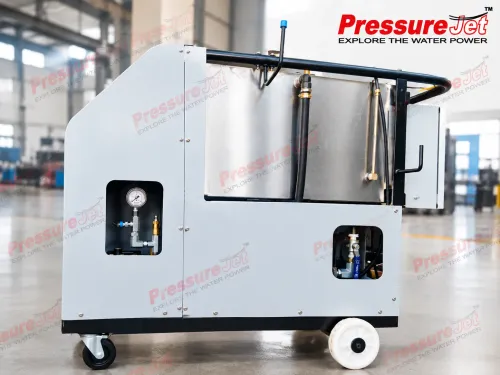
**PressureJet Systems Pvt. Ltd.** manufactures high-pressure reciprocating plunger pumps and customized high-pressure pumping systems for industrial applications.
Our high-pressure pump technology can be configured for applications requiring **controlled high-pressure water delivery**, including hydrostatic testing of boilers and other industrial pressure equipment.
Depending on the application, the system can be engineered around the required:
* Test pressure
* Flow rate
* Boiler/system volume
* Power requirement
* Operating environment
* Pumping arrangement
* Instrumentation and accessories
The objective is to provide a **reliable, controlled, and application-specific hydro testing solution** rather than simply selecting a pump based on maximum pressure.
##### Conclusion
Boiler hydrostatic testing is a critical procedure for verifying the integrity, strength, and leak-tightness of pressure-retaining components before commissioning or returning a boiler to service. A reliable high-pressure hydro test pump enables controlled pressure generation and supports efficient and dependable testing.
Selecting the right hydro test pump requires careful consideration of the required test pressure, flow rate, boiler volume, power requirement, testing frequency, and application conditions.
****Why Choose PressureJet for Boiler Hydro Testing?
PressureJet Systems Pvt. Ltd. manufactures high-pressure reciprocating plunger pumps and customized high-pressure pumping systems for industrial applications.
Our hydro test pump solutions can be selected according to the specific pressure, flow rate, boiler volume, and application requirements. Depending on the application, the system can be configured with a suitable pump, motor, pressure gauge, control arrangement, valves, hoses, and other required accessories.
This makes PressureJet high-pressure pump systems suitable for boiler hydro testing and other industrial pressure-testing applications where controlled, reliable, and efficient pressure generation is required.
Looking for a High-Pressure Hydro Test Pump for Boiler Testing?
Contact PressureJet with your required test pressure, flow rate, and boiler capacity to discuss a suitable hydro testing pump solution for your application.